Managing Tactical Allocation Within Governance Constraints: Best Practises for Institutional Investors
Master tactical asset allocation within governance frameworks. Essential best practices for institutional investors.

Acclimetry brings the investment side and the control side onto one record: strategic and tactical allocation, analysis of every portfolio, and the approved, versioned rules that monitor each policy, mandate and committee decision, with the evidence a board or auditor asks for.
For multi-asset and multi-manager portfolios, funds of funds, family offices, trustees, charities, foundations and asset managers.
Each allocation sets lower, target and upper weights by class for a portfolio or a portfolio group. Once its strategic bands are governed they are a rule: a change is requested, approved by someone other than the person who asked, and versioned. Tactical targets stay the manager’s working decisions.
Classes, sub-classes, types and strategies you define, in versioned taxonomies. Private-market commitments and vintages have rules of their own, and values convert at approved FX rates once a base currency is set.
Each manager’s mandate runs as its own portfolio, with its governing document and its own rules. Portfolio groups and an entity hierarchy hold the whole, the Analysis view adds it up, and related-portfolio limits measure an instrument or issuer group across several portfolios.
Fund holdings are recorded as dated compositions, so a limit can count what the funds hold, and the cash inside them. A fund with no usable composition is shown as held directly and disclosed, never estimated.
Every clause of the stored policy is given a disposition, and each rule is linked to the exact passage it comes from. Rules come from 32 templates, carry hard and warning bounds, and are approved by someone other than their author.
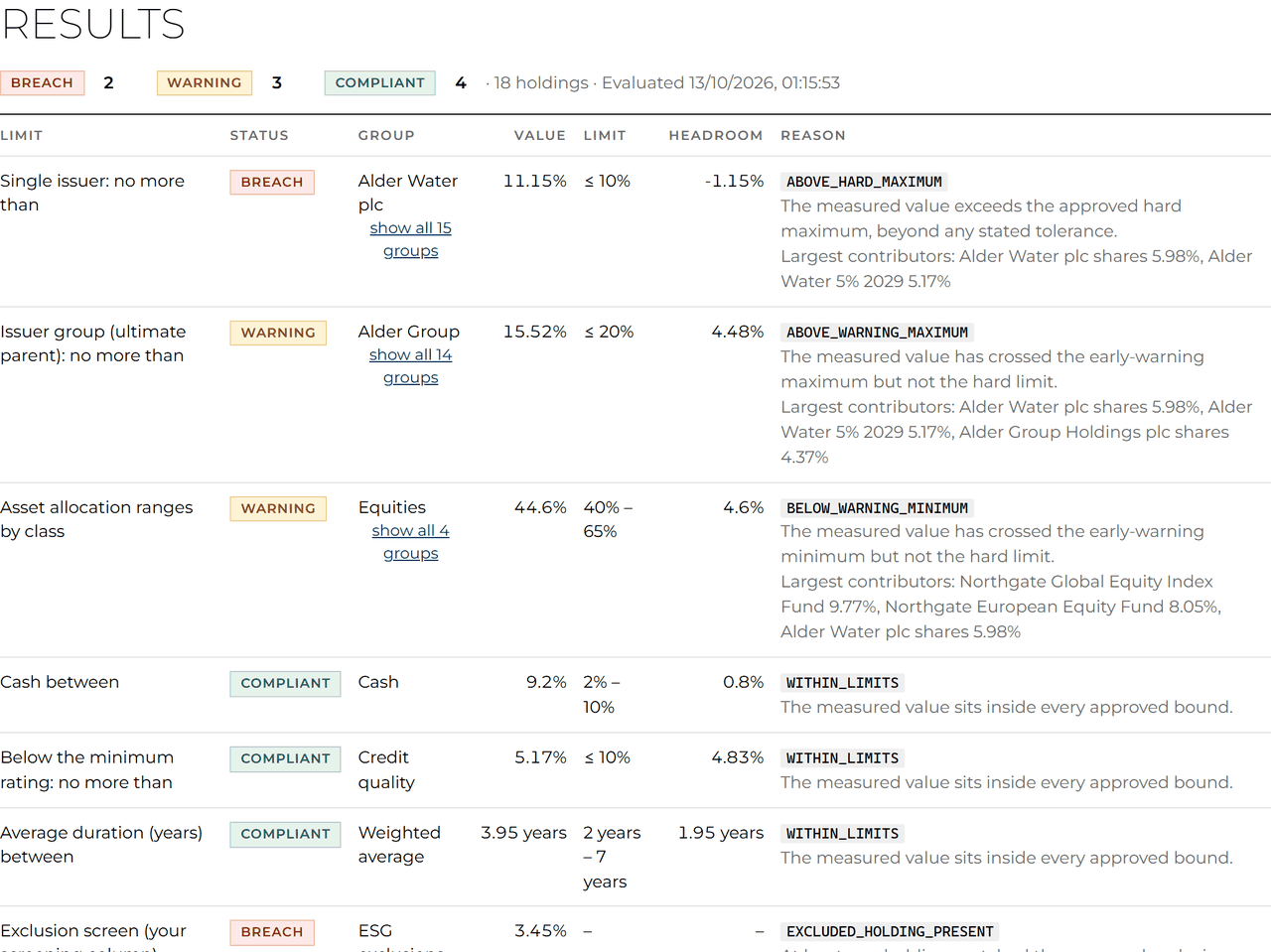
Monitoring runs return one of eight result states for every rule, with a reason code, the measured value, the headroom to the bounds and the largest contributors. Missing data is never read as compliant.
On the portfolio page the manager sees what the approved rules say about that portfolio, its governing policy, and the open cases with the questions compliance asked of them, and answers there. The answer is recorded on the case.
Trade Impact checks a proposed trade against the portfolio’s approved rules before it is executed, so the question “would this breach the policy?” is answered by the rules that will monitor the result.

Free tool
Test a holdings file against issuer, allocation, cash, credit, liquidity and exclusion limits in your browser, with the product’s own rule templates. Nothing is uploaded.
Open the Limit Checker
Library
Every limit type a policy or mandate sets: how it is worded, how it is measured, and worked examples computed by the Acclimetry rule engine.
Browse the restrictions
Asset allocation26 min read
Master tactical asset allocation within governance frameworks. Essential best practices for institutional investors.

Asset allocation33 min read
Master tactical allocation in fixed income. Navigate yield curves, credit cycles & optimize returns with dynamic strategies.

Investment policy23 min read
Essential guide to updating Investment Policy Statements. Discover review triggers, processes & best practices for institutional investors.

Bring a policy or a mandate: we will show how its allocation and its clauses become rules, and what monitoring them looks like.